Between 1. December and 5. December 2025 the annual MUR.AT WORKLAB 2025 will take place. Multiple venues in Graz including esc medien kunst labor, the mur.at head-offices at Leitnergasse 7, ████████████ and more TBA will host workshops, talks and concerts conceived of and organzied by the invited artists.
A detailed report including timetable, participants and infos about registration can be found at:
COLLECTIVE MEMORANDUM

FROM:             Lars Fabian Tuchel (@larsi)

SUBJECT:       Exhibition at Amalgam Festival in Graz
Introduction
From September 24th to 28th, 2025, the second Amalgam festival took place in the formerly abandoned Hornig Areal coffee roastery in the west of Graz. As part of the festival, the Collective Intelligence Association—with generous support from mur.at—presented the fourth and final iteration of their Collective Intelligence Access Point (CIAp) series.
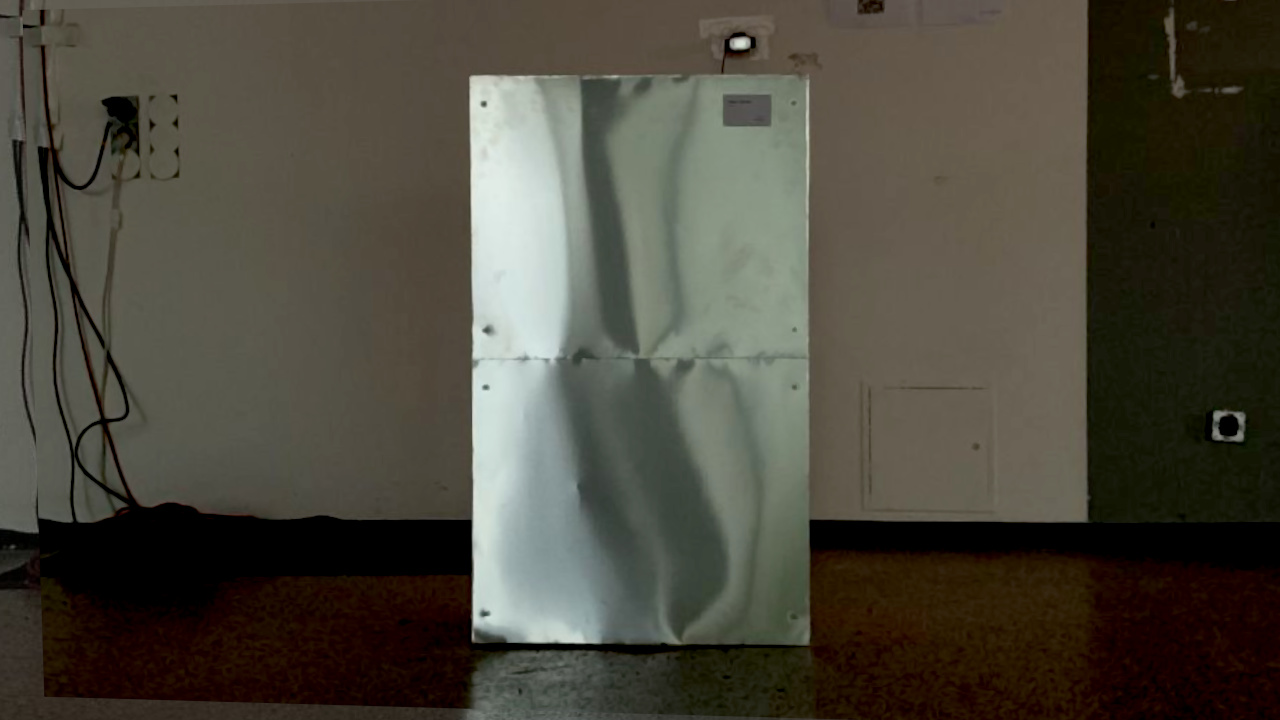
figure 1: Portrait of the CIAp.
Collective Intelligence Access Point
The CIAp also deployed for the festival featured a custom-built keyboard interface, constructed by the team in March 2025. The main structure is a wooden box (approx. 90x20x60cm), sheathed in thin metal plates held together by a preliminary layer of solder and a very confident application of silver tape. (The welding skills and equipment available to the CIA remain a field for potential growth.)
Embedded in the top is a vandalism-proof keyboard, sourced from a only-slightly-shady seller on eBay. The keyboard connects to a Raspberry Pi microcomputer, which in turn is linked to a webcam— on of three different models officially acquired with mur.at funds from three different local electronics stores in three different countries. Video output is handled by a small, full-HD projector, generously loaned from L██ T███’s private equipment stash. This projector was ceiling-mounted using an ingenious combination of zip ties and a generous amount of tape, an installation undertaken at great personal risk to CIA members using what was possibly the worst, most unsafe, and creakiest ladder imaginable. We are happy to report no damage to personnel or property occurred.
All technical components and excess cabling are neatly stored within the box’s lower compartment. For internet access, the microcomputer connected to a Wi-Fi router and data contract temporarily pilfered from one of the private residences of Z██ Z███ and L██ T███ for the festival’s duration.
Once set up, the CIAp was largely self-sustaining. Aside from the occasional internet dropout or vandalism attempt that required a simple restart, it ran autonomously throughout all five days of the Amalgam festival.
figure 2: Start of setup on Day 1
A Number of Ideas that Shaped the Conception and Creation of the Collective Intelligence Accesss Points
As sound artists, all four members of the CIA maintain a deep and lasting interest in the exploration of S P A C E. While this interest manifests differently across their individual practices, a common thread is the concept of overlapping spaces. In their work, they consistently engage with numerous simultaneous instances of architectural, acoustic, social, and poetic spaces. When working with these layered realities, both the borders and bridges between them must be carefully considered and shaped.
The CIAp project is a further exploration of these spatial ideas. The questions and concepts that informed its creation include, but are not limited to:
Bridging Digital and Physical Space: The physical, interactive component of the CIAp aims to place the ephemeral—and often elusive—space of net-art directly into the space inhabited by the prospective audience.
Creating Synchronous Digital Space: The simultaneous hosting of video and audio streams connects geographically distant physical spaces. This creates a shared, synchronous digital space that exists independently of location, potentially offering participants an experience of connection that transcends politically imposed borders.
Spatial Software vs. The Algorithmic Feed: The 2D canvas of the agora board (developed by taat.live) is an instance of spatial software. It stands in contrast to the current trend of infinite, algorithmically-driven scrolling feeds, inviting a more explorative and emancipatory approach to digital interaction.
Net-Art as Archival Space: Net-art projects often contain both time-based and sculptural aspects. After the initial influx of visitors, they can become archives of themselves. The question of what spaces are available to retain history and collective knowledge becomes ever more pressing in an age of LLM-generated nonsense and state-mandated historical revisionism.
The Toilet Stall as a Collective Canvas: Toilet stalls are, in one sense, deeply private spaces, yet they can also become sites of collective expression. Here, anyone with a marker can participate in a collective, site-specific, long-durational artwork. Defecation is both a highly individual act and a universal human experience. The CIAp’s canvas seeks to extrapolate the raw, creative potential found on toilet stall walls across the globe.
figure 3: ████ ███ and ████ ███ ██ ███
Questions and Themes for the People
All four iterations of the CIAp throughout the year began with their own unique agora board. For each, we experimented with different approaches to guiding—or not guiding—our visitors.
For the first installation in Graz and Rome, we imposed a strong visual structure on the agora space. The board was divided: the left side featured photos and information about the event in Rome, and the right side had the same for the event in Graz. While this created an inviting and organized initial look, the strict spatial separation ultimately hindered direct communication between the two locations. Our provided content consisted of extensive information about the events, the involved collectives (including mur.at, CMKK, BitNet01, and Mille Plateaux), and documentation of the CIAp’s creation process.
For the second iteration in Graz and at the Fusion Festival, we shifted from providing facts to posing questions. We moved away from an informational model, aiming instead to provoke a different kind of engagement. The board was populated with open-ended prompts about collectivity and listening, designed to resonate with the festival’s chaotic, collective energy. The goal was to seed the space with conceptual starting points, inviting visitors to become co-thinkers rather than just consumers of content. The questions included:
Who do we need to listen to right now?
What would an online riot look like if it was silent?
Is this surveillance or care?
Is it possible to resist passively, collectively?
Building on the question-based approach but learning from prior technical difficulties, we designed the third iteration for asynchronous discussion, as only one point was active at a time. Hosted during the fifth edition of CMKK and dedicated to our Lady of Discord, the questions thematically revolved around the number F I V E:
When five people make a decision—is it still a discussion, or already a structure of power?
Why do we consider a five-day workweek and two-day weekend a “balance”?
If we have five senses, why are we taught to trust only what we see?
If each of us plays five social roles […] which one is real?
If justice had only five principles, which ones would society be most willing to sacrifice?
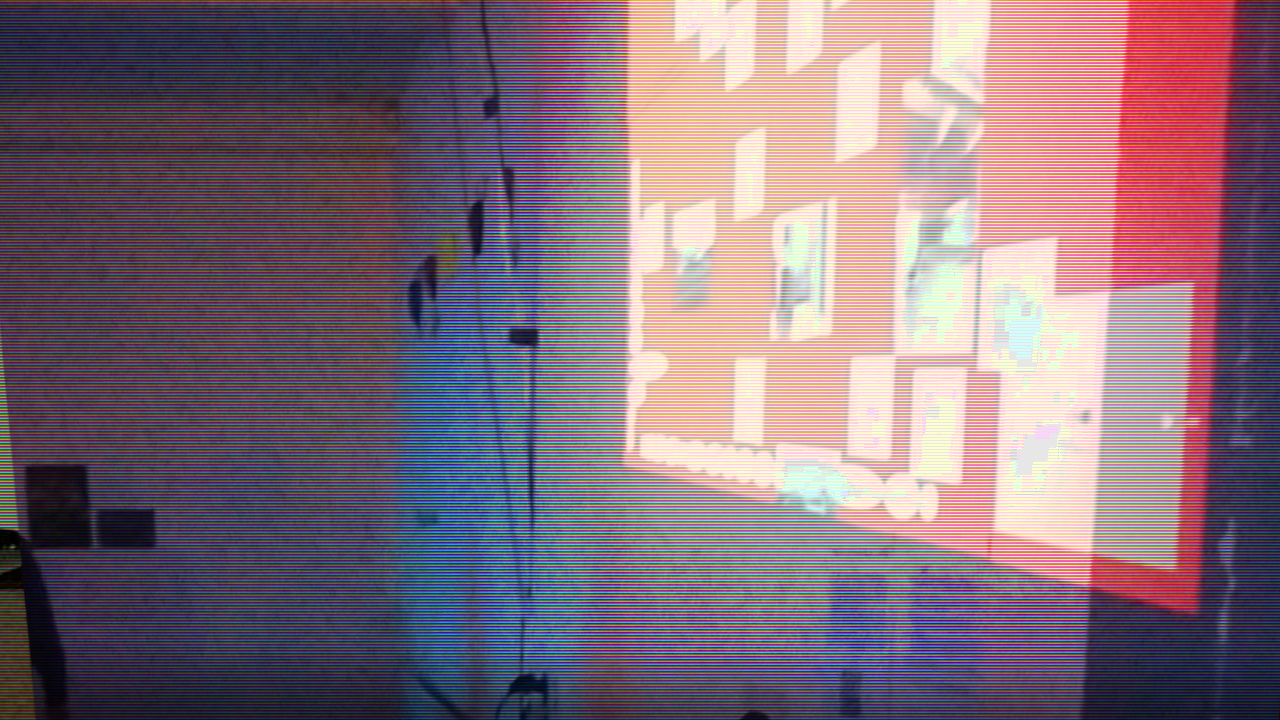
For the final iteration at the Amalgam Festival, we chose to experiment with a blank slate. Just as the festival location itself was an abandoned ruin but a week before the opening, participants were initially greeted by nothing but a bright red, empty canvas. Recognizing that the interface was not self-explanatory, we added a short paper guide to the wall to avoid cluttering the digital space with instructions. Despite this initial lack of direction, we at times observed genuine interactions between visitors on the canvas. Perhaps the absence of a hierarchy between curated content and audience contributions allowed for a more fluid and organic communication model to emerge.
figure 4: F████ C███ explains the installation to a visitor.
Audience Encounter Reports (Amalgam Festival)
An important insight gained already by the first CIAp(1/1) that in times of billions being invested into more or less shady UX experiments and practices, interface can’t afford even the slightes bit of resistance. Even a proper mouse and keyboard can for some people be considered too clunky and outdated to be considered a proper interface. Therefore very few people were willing to go through the initial moment of frustration that was necessary before being able to use the platform. Strong technical and emotional support by the CIA members was therefore required.
Despite this knowledge the strategy could not be properly executed during Amalgam as all CIA members were also participating in the festival in other roles (some of which had to be filled very last minute), such as stage management, admission, bar shifts, technical support, PR as well as performing themselves. Therefore we must concede that the intelligence gathering had not been carried out to its most efficient degree.
The reactions we got in the time we managed to support the CIAp were mostly what is to be expected: a polite “Wow, nice” or a thoughtful “Aha, cool.” Even after a member explained how the access point worked, people were often hesitant to actually write anything. It didn’t seem to matter if we gave them guiding questions or a blank slate—that initial hurdle was real.
An noteworthy development we observed was a bit of recognition. Quite a few people mentioned they’d seen our box before at Forum or Dom im Berg, which could be considered nice or even cool.
The occasional attempt at vandalism – for example with one person asking: “Can I put my ass-pic there?” - turned into actual “vandalism” during the late hours of the big 24 hour concert and club event between Friday and Saturday. A few people made use of the CIAp’s complete lack of safety measures, closed the web-browser, installed the video game █████ on the mico-computer and had it run with approximately 5 FPS for the last few hours of the night. And even though no intelligence could be collected it turned out to me a place of collective gathering.
All of this can somehow be expressed in one comment an anonymous participant made earlier on Friday. Looking at the installation in the context of the whole festival, they said: “Ah, so it’s a collective intelligence of a collective amalgam, I see.” And in the end, between that thought and the late-night gaming session, that’s exactly what it became.
figure 5: Evidence of the vandalism act with a number of suspects.
Further Developments
We have identified five major areas of improvement:
UX: By improving the ease of use of the interface and platform, at least a few moments of frustration could be prevented, leading to an increase in contributions and intelligence. These improvements could include:
Easier movement through the canvas board.
Keyboard shortcuts for important actions.
Interactive tooltip-led support for when no CIA members are personally present.
Generally reducing the number of actions required to add anything to the board.
Connecting the two locations’ canvases in some way to strengthen the experience of a shared common space.
Security: As mentioned before, the security measures of the Collective Intelligence Access Point are basically non-existent. With the press of two buttons, the whole thing can be brought to a halt. Luckily, the access points have been hosted in very good-natured environments, so only one (successful) attempt at sabotage occurred.
A simple measure would be to have a bash script running in the background that checks if the expected kiosk-mode browser process is still up. If it isn’t, we could play a very loud alarm sound or simply restart the Raspberry Pi.
Real-Time: Focus more on the video/audio-streaming aspect of the access points, both between two or more CIAps and with the visitors’ own devices. This worked especially well during the first iteration and proved quite effective in creating a collectively shaped space.
Stability: The system we were using to mount the projector for the canvas in Graz was sketchy at best and outright dangerous at worst. By engaging primarily with digital spaces, the CIA failed to reconcile with the requirements and risks of things existing in actual physical space.
Presence: Actually follow through with in-person support of audience members in the spaces where we set up the CIAps. No matter the cost. For the sake of intelligence.
figure 6: ████████████████████
Conclusions
The █████ ████ ████████ (███████) █████ ‘███████, ████████’. ██████ █████████ █████ ‘████’, but it ███ ████ be ████ ‘███████’. █████ █████████ this in ███ ███████████. At █████ ██ ████████ to a ██████ ███████ which ████████ to ████████ a ██████ ████’s █████ (████ ███████), but ██ had █████ of and been █████ a █████ ██████ of the ██████ ████████, to which ██ ████████ as a “███████ █████ ███ █████████ ██████ █████████ ██████. In ██████, this █████████ is ████████ by the ████ ████████ which ████ ███ ███████████ ████ a ████ used for ██████. ██████████ was the ████████ ███████████ of █████████████ among ██████ ████████ in the ████ ██████████ ███████. In ███████, ‘███████ ██████’ ██████ a █████ █████████████ to this.